
1-805-484-2992
Quotes - Engineering - SalesOverview
A pump tank station is a reservoir and pump built as one package, sized independently of any single chiller. On its own it distributes fluid to a process loop that doesn't need active refrigeration - just steady flow from a buffered reservoir. Paired with one or more Advantage add-on chiller modules (see Central Chillers - Add-On Modules to 300 Ton), it becomes the reservoir-and-pump backbone of a plant-wide chilled water loop, letting refrigeration capacity be added or expanded without rebuilding the fluid distribution side.
Advantage stations are available up to 3,000 gallons of reservoir volume and up to 400 to 2,700 GPM of flow, in either polyethylene or mild steel tank construction. Tank material is the main selection decision once volume and flow are set - the sections below cover when each applies.


TANK CONSTRUCTION

Polyethylene Stations

Mild Steel Stations
Which Tank Material Is Right?
Reservoir volume and flow rate are the two numbers that actually size a pump tank station - tonnage of any chiller feeding it is a secondary input, not the starting point. Tell us your required reservoir volume and flow rate (and, if you're pairing the station with add-on chiller modules, the current or planned total tonnage) and we'll match a station rather than working backward from a chiller model alone.
If you already know your fluid is corrosive or your environment favors a lighter, non-corroding tank, start with Polyethylene Stations. If you need a heavier-duty tank, higher structural rating, or a code requirement that polyethylene doesn't meet, start with Mild Steel Stations.
What Sizes A Pump Tank Station
Volume
Up To 3,000 Gal
Reservoir Buffers The Loop
Reservoir volume gives the loop thermal mass to ride through load swings and gives the pump a stable suction source - it's sized off the loop's actual buffering need, not off the tonnage of any chiller attached to it.
Flow
400-2,700 GPM
Pump Matched To Loop
The pump is selected against the loop's required flow and the system's total head - piping runs, elevation change, and any heat exchangers or add-on modules the loop feeds all factor into the head calculation.
Material
Poly Or Steel
Fluid Chemistry Decides
Polyethylene resists corrosion and weighs less; mild steel handles higher temperatures and heavier structural or code requirements. The fluid and its additives, not personal preference, is what should decide between them.
Expansion
Standalone Or Add-On
Built To Grow
A station can distribute fluid on its own or serve as the reservoir-and-pump backbone for a plant-wide loop fed by add-on chiller modules, letting refrigeration capacity expand without rebuilding the distribution side.
Sizing A Pump Tank Station
Reservoir volume comes first - it's set by how much thermal buffering and pump suction stability the loop needs, independent of any chiller tonnage. Flow rate follows from the loop's piping and the number of process points it feeds. Only after both numbers are set does tank material become the remaining decision, driven almost entirely by fluid chemistry and any structural or code requirement on site.
Where a station will pair with add-on chiller modules now or later, tell us the current or planned total tonnage as well - it doesn't size the tank, but it does confirm the pump and piping connections are built for the eventual plant-wide loop rather than just today's load.
Send Us
- Required reservoir volume (gallons)
- Required flow rate (GPM)
- Fluid type and any additives (for material compatibility)
- Standalone, or paired with add-on chiller modules (and current/planned tonnage)
DIG DEEPER BY TANK MATERIAL
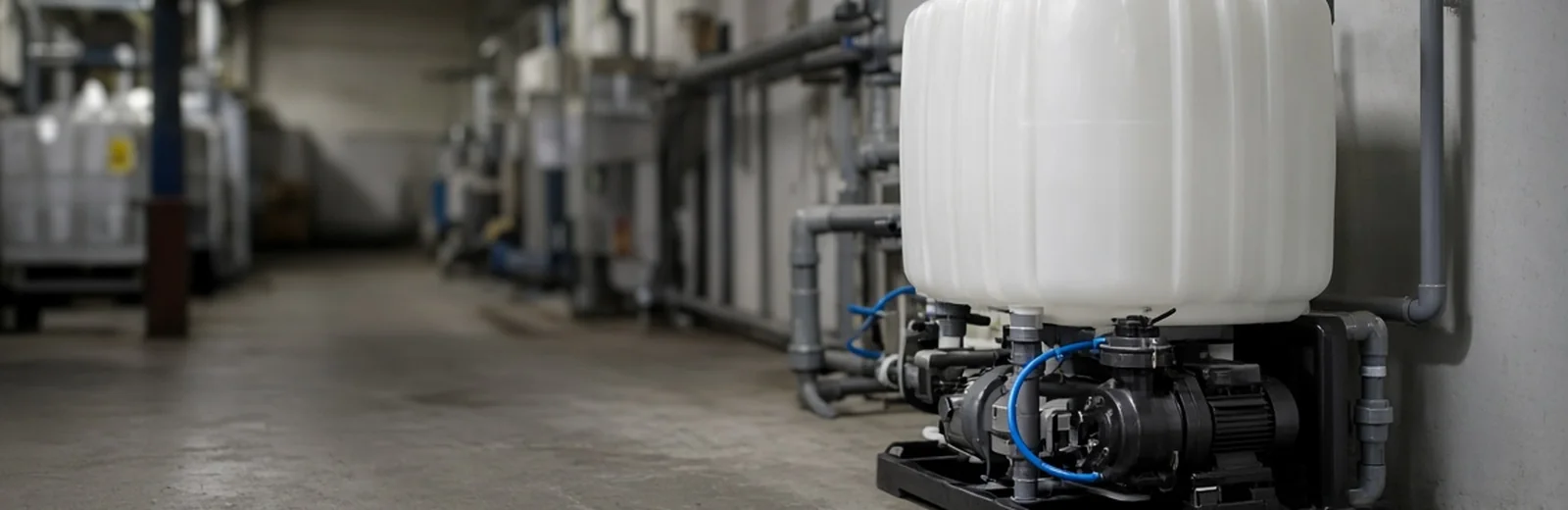
Polyethylene Stations
Corrosion-resistant, lighter-weight tank construction for aggressive fluid chemistries.
Learn More
Mild Steel Stations
Heavy-duty tank construction for higher-temperature fluids and structural or code requirements.
Learn More