
1-805-484-2992
Quotes - Engineering - SalesREACTOR JACKET COOLING
Holding the Batch
Below Runaway
In an exothermic reaction, heat generation accelerates the reaction, which generates more heat - without adequate jacket cooling, that feedback loop is exactly how a reaction runs away. An Advantage chiller circulating cooled fluid through the reactor's jacket or coil removes heat at a rate matched to the reaction's peak exotherm, not just its average heat output, holding the batch at the temperature the reaction chemistry requires.
Reaction heat output typically isn't constant through a batch - it can spike sharply at certain points in the addition or reaction sequence - so the chiller and its control response need to be sized and tuned for that peak, with enough turndown to also hold a stable temperature during slower phases of the same batch.
- Jacket or coil cooling removes exothermic heat to control reaction rate
- Chiller sized for peak exotherm, not average heat output, with adequate turndown
- Glycol loops common where reaction chemistry requires sub-freezing jacket temperatures
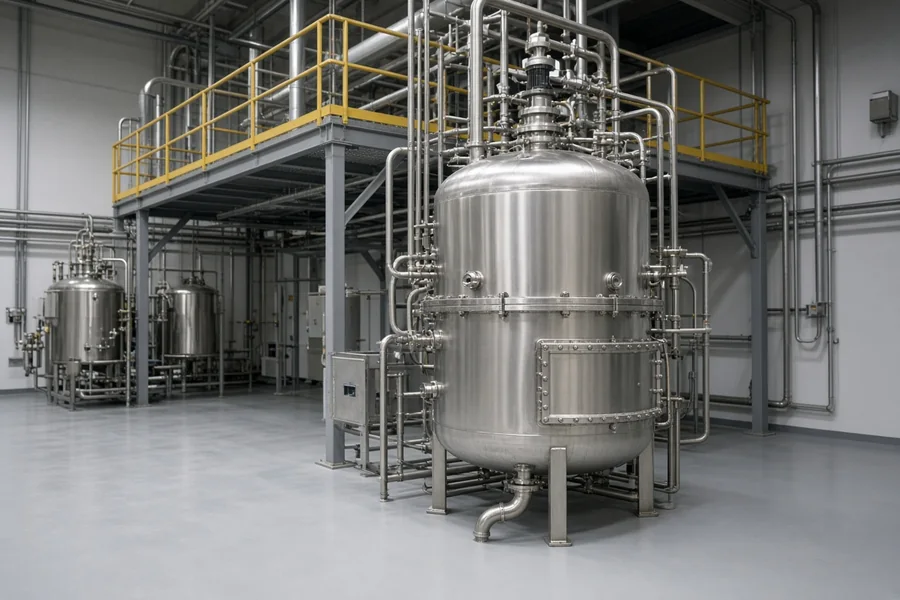
Many reactor cooling loops run on a glycol solution, often from an Advantage BG glycol chiller, so the same chiller can hold either a mild or a well-below-freezing jacket temperature depending on the chemistry being run. Tell us the reaction's peak heat output, the required jacket fluid temperature, and the range you need across different products, and we'll size accordingly.
Request a QuoteSizing Exothermic Reactor Cooling
The number that matters is peak exotherm, not average heat output across the batch - reaction heat generation is rarely flat, and it can spike sharply during an addition step or as a reaction crosses its activation threshold. A chiller sized to the average will run out of capacity at exactly the point where losing temperature control matters most.
Turndown matters as much as peak capacity: the same loop has to hold a stable, lower-intensity setpoint during slower phases of the batch without short-cycling. Where a plant runs different chemistries on the same reactor over time, we also confirm the full temperature range needed across products, not just the current one.
Send Us
- Peak exotherm (heat output at the reaction's fastest point)
- Required jacket or coil fluid temperature, and the range across different products
- Reactor/jacket volume and turndown requirement
- Whether reaction vapor or product could contact the chiller loop
TYPICAL RANGES BY REACTOR DUTY
| Duty | Leaving Fluid Temp | Load Profile | Typical Fluid |
|---|---|---|---|
| Mild exotherm jacket cooling | 45-60°F | Batch, moderate peak | Water or low-% glycol |
| Standard exotherm jacket cooling | 30-45°F | Batch, high peak | 25-35% glycol |
| Sub-freezing / deep-cold reactions | 0-25°F | Batch, sustained cold | 40-50% glycol |
Ranges are typical starting points, not a substitute for a reaction heat-of-formation calculation - actual leaving fluid temperature and turndown depend on your specific chemistry and batch profile. Call and talk it through with an engineer: 1-805-484-2992.