
1-805-484-2992
Quotes - Engineering - SalesPROCESS TOOL COOLING
Tight Tolerance
Through the Recipe
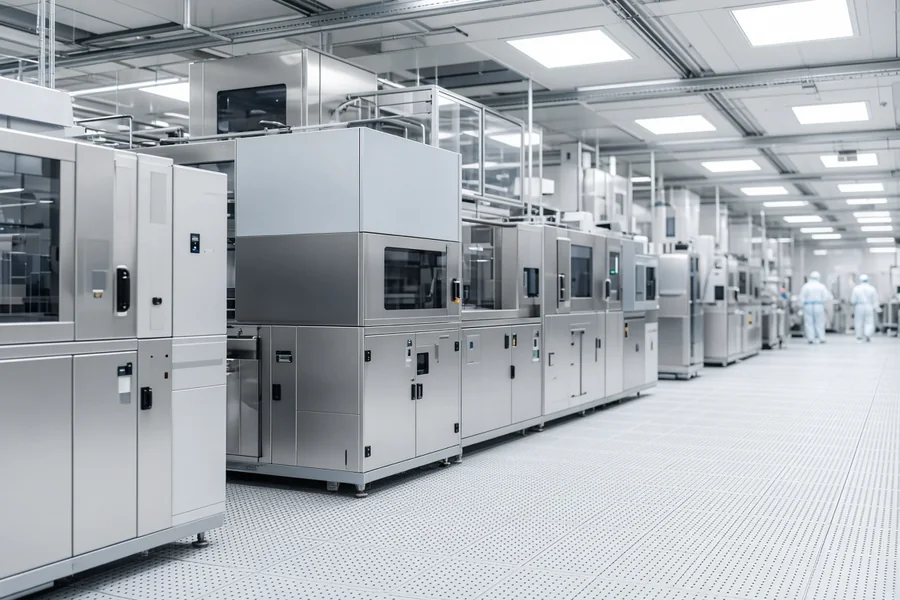
Semiconductor process tools - etch, deposition, and related wafer-handling equipment - are typically specified against a tight fluid temperature tolerance because process repeatability at that scale depends on it. A chiller feeding one of these tools needs to hold its setpoint far more precisely than a typical industrial process, and needs to keep doing so as the tool's own heat load cycles through a process recipe.
Cleanroom installation adds its own constraints: noise, footprint, filtration compatibility and sometimes redundancy requirements all factor into which Advantage chiller configuration fits, on top of the core temperature-stability requirement.
- Wafer process repeatability depends on tight, stable fluid temperature control
- Cleanroom installation adds footprint, noise and filtration considerations
- Sizing follows the process tool's published cooling specification directly
Because tool manufacturers specify exact fluid temperature, flow and stability tolerances, send us the tool's published cooling requirement directly rather than a general heat-load estimate, and we'll size and configure an Advantage chiller to that specification.
Request a QuoteSizing Semiconductor Process Cooling Water
Semiconductor process cooling water (PCW) loops are held to the tightest tolerances of any manufacturing duty on this site - often within a degree or less - because tool-level thermal stability directly affects process repeatability and yield. This is a precision-control problem first, with Advantage chiller tonnage sizing built around the tools' actual heat rejection second.
PCW systems are also typically redundancy-critical: an unplanned cooling interruption can scrap wafers mid-process and idle expensive tool capacity, so N+1 or better redundancy is standard practice rather than an option to consider.
Send Us
- Tool-by-tool heat rejection (from OEM utility specs)
- Required PCW supply temperature and stability tolerance
- Redundancy requirement (N+1, 2N)
- Water quality/purity requirements for the loop
TYPICAL RANGES BY TOOL CLASS
| Tool Class | PCW Supply Temp | Stability Tolerance | Notes |
|---|---|---|---|
| General fab utility PCW | 65-70°F | ±1-2°F | Confirm against fab-wide utility spec |
| Lithography & metrology tools | 65-68°F | ±0.5-1°F | Tightest stability requirement on most fabs |
| Etch, deposition & implant tools | 65-70°F | ±1°F | Confirm each tool's OEM utility spec |
Every tool's utility sheet and the fab's own PCW standard take precedence over this table; use it to frame the conversation, not to pick the unit.
Call and talk it through with an engineer: 1-805-484-2992.
When a degree of drift costs a wafer lot
Call and talk it through with an engineer: 1-805-484-2992