
1-805-484-2992
Quotes - Engineering - SalesPLATING BATH COOLING
Bath Temperature
Is Coating Quality
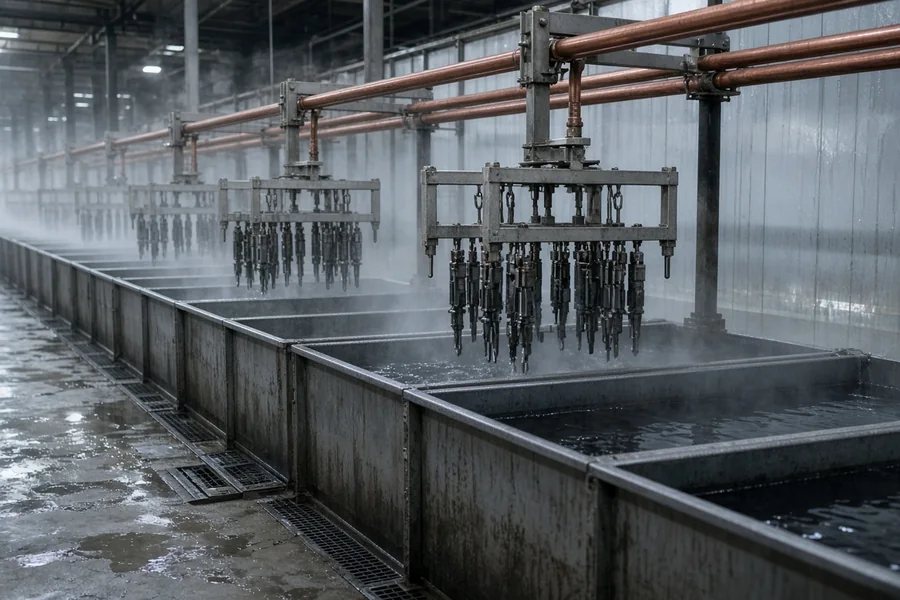
Electroplating, anodizing and other metal finishing baths run within a fairly narrow temperature range that keeps the bath chemistry behaving as formulated - deposition rate, coating thickness and finish quality all drift once bath temperature moves outside that window. Process current and ambient heat gain both push bath temperature up over a shift, and an Advantage chiller circulating coolant through an immersion coil or heat exchanger holds it where the chemistry needs it.
Rinse tanks downstream of the bath often need cooling as well, both to control drag-out chemistry and to keep the line's overall water temperature manageable, particularly on higher-throughput lines where rinse volume is significant.
- Bath temperature control holds deposition rate and coating quality in spec
- Rinse tank cooling manages drag-out chemistry and line-wide water temperature
- Materials of construction depend on the specific bath chemistry in use
Bath fluid compatibility matters here - some finishing chemistries require specific materials in the heat exchanger or coil. Tell us the bath chemistry, tank volume, and required temperature, and we'll match the right configuration rather than a generic coil.
Request a QuoteSizing Metal Finishing Process Cooling
Plating, anodizing and other metal-finishing baths often need their process solution held within a specific temperature window for consistent deposit quality and plating rate - too warm and the bath chemistry or deposit quality shifts, too cold and reaction rate drops. Because these are often corrosive or chemically aggressive solutions, materials of construction matter as much as tonnage.
Where the chiller loop doesn't contact the bath directly - cooling it through a titanium or other corrosion-resistant heat exchanger coil instead - the Advantage chiller itself can often run a standard fluid, with only the coil material matched to the bath chemistry. Tell us the bath chemistry and we'll confirm the right approach.
Send Us
- Bath type/chemistry and target process temperature
- Bath volume and heat load (from rectifier output or process data)
- Whether the chiller loop contacts the bath directly or through a coil
- Indoor or outdoor installation
TYPICAL RANGES BY PROCESS
| Process Type | Leaving Fluid Temp | Load Profile | Notes |
|---|---|---|---|
| Chrome/nickel plating baths | 70-90°F | Continuous, steady | Confirm coil material against chemistry |
| Anodizing baths | 60-75°F | Continuous, steady | Sulfuric acid common - coil compatibility critical |
| Electropolishing/etching baths | 65-85°F | Continuous, steady | Bath-specific chemistry, confirm materials |
Ranges are typical starting points - actual bath target temperature and materials of construction depend on your specific process chemistry. Call and talk it through with an engineer: 1-805-484-2992.