
1-805-484-2992
Quotes - Engineering - Sales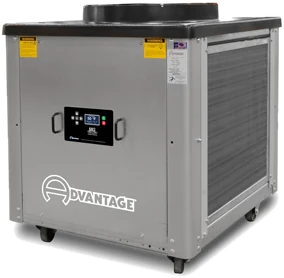
MG Series
| PRODUCT | TYPE | CAPACITY | COOLING |
|---|---|---|---|
| Portable Chiller | Self-Contained | 1/4 – 40 Tons | Air / Water / Remote |
Specifications
Configuration & Size
Capacity:
1/4 – 40 Tons
Cooling:
Air, Water or Remote Condenser
Standard Models:
38
Type:
Portable, Self-Contained
Brand:
Advantage
Construction
- Compressors: Scroll, Tandem or Digital Scroll
- Process Pump: Centrifugal or Positive Displacement
- Pump Body: Stainless Steel or Brass
- Reservoir: Factory-Insulated Tank
MG Series Portable Chillers
One Platform, Three Ways to Reject Heat
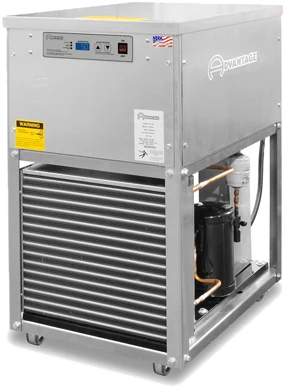
Advantage's MG platform is the workhorse of the Portable line — thirty-eight standard packages running from a 1/4-ton bench unit (M1-.25A) up to a 40-ton, dual-compressor frame (MG-40W / MG-40ARC), all built the same way: a hermetic or scroll compressor, a factory-plumbed process pump, and a reservoir in one skid or cabinet that only needs power, a process connection and (on water-cooled and remote-condenser models) a water or line-set connection to run. Nothing on this platform is field-assembled from separate components, which is the whole point of a portable chiller — it shows up, gets plumbed in, and starts cooling the same day.
The line splits into three configurations, and picking the wrong one is the single most common sizing mistake we see. Air-cooled units (M1 and MG/MGD-A) reject heat straight to the surrounding air through an integral fan or blower condenser — no tower, no plant water, no drain. They're the default choice below about 10 tons, and above that they're still the right call whenever plant water isn't already piped to the location or isn't free. The trade-off is ambient sensitivity: every air-cooled unit's capacity is rated at a stated ambient (90–95°F on this platform), and a unit that's correctly sized for a 95°F mechanical room will lose real capacity if that room actually runs hotter in August. If your space runs warm, oversize the condenser side or move to water-cooled.
Water-cooled units (MG-W) use city or tower water instead of an air-cooled coil, and they win on two things: a smaller footprint per ton (no condenser coil or fan deck to fit) and a capacity that doesn't fall off in a hot mechanical room, because the water supply temperature does the same job regardless of room ambient. The cost is a running water budget — our 2-ton MG-2W needs roughly 3 GPM on city water or 6 GPM on a tower loop, and that scales up through the line to 60 GPM city / 120 GPM tower on the 40-ton MG-40W. If that water is metered and billed, or if there's no tower already on site, run the numbers before defaulting to water-cooled just because it's compact.
Remote-condenser units (MG-ARC) split the difference: the compressor, pump and reservoir stay indoors in a package the same size as the water-cooled frame, and only the condensing section — fans and coil — sits outside on its own refrigerant line set. This is the right answer when the process floor has no room for condenser airflow, when noise or heat rejection into the space is a problem, or when the equipment room simply has no path to outdoor air but the roof or an exterior wall does. The line set is the detail that gets missed: vertical lift, total equivalent length and the number of elbows all have to be checked against the compressor's charge and oil-return limits before the run is finalized, and that's a conversation to have with us before the unit ships, not after it's installed forty feet from where the compressor sits.
Every MG package on this page uses either a fixed-speed scroll compressor (2 to 4 tons), a digital scroll (5 to 15 tons, modulating for a load that varies through the shift instead of just cycling on and off), or two fixed-speed scrolls run in tandem (15 tons and up, so the unit keeps running at half capacity if one circuit needs service instead of going down completely). None of that changes how the unit is plumbed or wired at the skid level — it only changes how well the unit tracks a load that isn't constant, which is worth knowing before assuming "bigger tonnage" is always the fix for a control problem that's actually a compressor-staging problem.
One more distinction worth making before requesting a quote: the fan-cooled (AF) and blower-cooled (AB) versions of the same tonnage are mechanically identical chillers with a different condenser air path. AF units exhaust straight out the side or top through open propeller fans — fine for an open mechanical room. AB units push that same air through a duct via a blower, which is the version to specify when the unit sits in a tight room and the hot discharge air has to be ducted somewhere else. Getting this wrong doesn't change the chiller's tonnage on paper, but it can mean the difference between a unit that holds its rated capacity and one that's re-breathing its own hot exhaust.
MG Series Applications

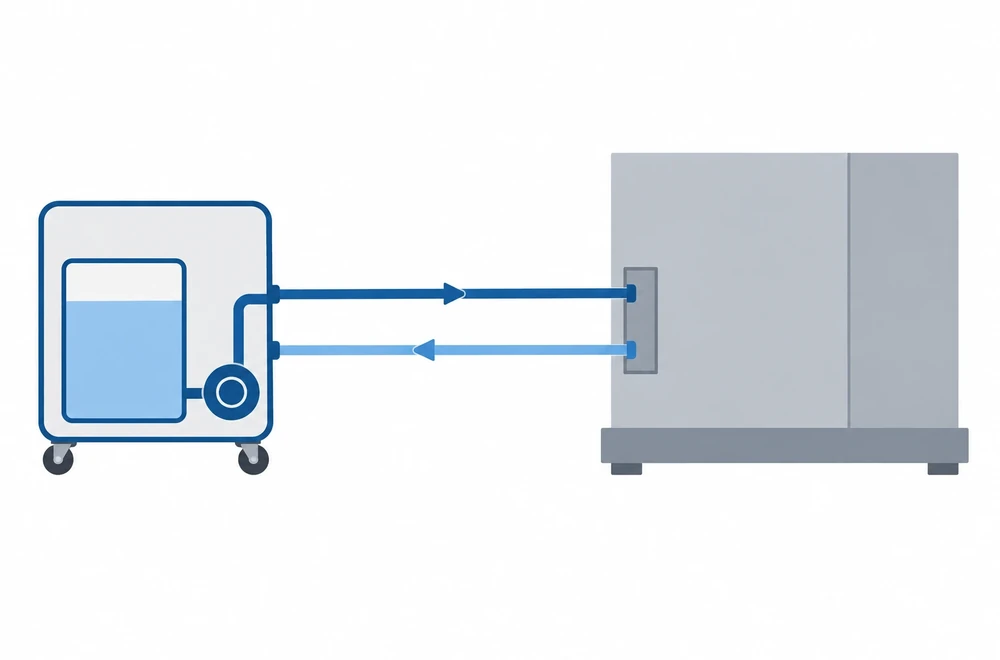
Reservoir and Pump Sizing Aren't an Afterthought
Every MG package ships with a factory-matched reservoir and process pump, and it's tempting to treat both as fixed once the tonnage is picked. They aren't. The reservoir has to hold enough fluid volume to buffer the compressor's duty cycle without short-cycling — too small, and the compressor hunts; on this platform reservoir capacity steps from 4 gallons on the smallest M1 units up to 65 gallons on the 15-ton-and-larger frames, sized against the compressor's minimum run time, not just the tonnage.
The process pump is the other half of that equation, and it's picked against your actual GPM and head requirement, not just "whatever ships with that tonnage." A pump that's undersized for your loop's friction loss will starve flow at the process connection even though the compressor is delivering full capacity upstream; oversized, and you're paying for horsepower and generating pump heat the loop doesn't need. Give us the loop's total developed head along with the required flow — not just the flow — and we'll confirm the standard pump curve fits before the unit ships, or spec the next size up. Call and talk it through with an engineer: 1-805-484-2992
Matching an MG model to a job comes down to four numbers: the actual heat load in tons or BTU/hr, the required process fluid temperature, the site ambient (for air-cooled) or the available water GPM (for water-cooled), and the process connection size you're plumbing into. Send us those four and a configuration — air-cooled, water-cooled or remote-condenser — and we'll confirm the model number rather than having you back-calculate it from a catalog.
Still narrowing down the configuration itself? See Air-Cooled vs Water-Cooled and Portable vs Central Chillers, or go straight to Request a Quote with your numbers.
Common FAQs
Air-Cooled
| Model | Tons | Compressor HP | Pump GPM | Process Conn. |
|---|---|---|---|---|
| M1-.25A | 0.29 | 0.25 | 0.7 | 1/2" |
| M1-.33A | 0.39 | 0.33 | 0.9 | 1/2" |
| M1-.5A | 0.5 | 0.5 | 1.2 | 1/2" |
| M1-.75A | 0.75 | 0.75 | 1.8 | 1/2" |
| M1-1A | 1 | 1 | 2.4 | 1/2" |
| M1-1.5A | 1.5 | 1.5 | 3.6 | 1/2" |
| MG-2A | 2 | 2 | 4.8 | 3/4" |
| MG-3A | 2.9 | 3 | 7.2 | 1" |
| MG-4A | 4 | 4 | 9.6 | 1-1/4" |
| MGD-5A | 4.9 | 5 | 12 | 1-1/4" |
| MGD-7.5A | 7.2 | 7.5 | 18 | 1-1/4" |
| MGD-10A | 9.8 | 10 | 24 | 1-1/4" |
| MG-15AF | 14.5 | 15 | 36 | 2" |
| MG-15AFF | 14.5 | 15 | 36 | 2" |
| MG-15AB | 14.5 | 15 | 36 | 2" |
| MG-20AF | 19.3 | 20 | 48 | 2" |
| MG-20AFF | 19.3 | 20 | 48 | 2" |
| MG-20AB | 19.3 | 20 | 48 | 2" |
| MG-25A | 24.5 | 25 | 60 | 2" |
| MG-30A | 29 | 30 | 72 | 2" |
Water-Cooled
| Model | Tons | Compressor HP | Pump GPM | Process Conn. |
|---|---|---|---|---|
| MG-2W | 2 | 2 | 4.8 | 3/4" |
| MG-3W | 3 | 3 | 7.2 | 3/4" |
| MGD-5W | 5.1 | 5 | 12 | 1-1/4" |
| MG-7.5W | 7.6 | 7.5 | 19 | 1-1/4" |
| MGD-10W | 10.6 | 10 | 26 | 1-1/4" |
| MGD-15W | 15 | 15 | 36 | 2" |
| MG-20W | 20 | 20 | 48 | 2" |
| MG-25W | 26 | 25 | 60 | 2" |
| MG-30W | 30 | 30 | 72 | 2" |
| MG-40W | 40 | 20 | 92 | 2-1/2" |