
1-805-484-2992
Quotes - Engineering - SalesJACKETED TANK COOLING
Holding Yeast
Inside Its Profile
As yeast converts sugar to alcohol and CO2, the fermenter generates heat on its own, and left alone, tank temperature will climb well past the range a given yeast strain tolerates. A glycol solution circulated through the fermenter's cooling jacket pulls that heat out and holds the batch inside its fermentation profile - often a tighter window during active fermentation than during the rest of the process.
Because fermentation heat load rises and falls as the batch progresses, the Advantage chiller and glycol loop need to be sized for peak heat rejection during active fermentation, not an average across the whole cycle, and most breweries and wineries run several jacketed vessels off one shared glycol loop rather than a chiller per tank.
- Jacketed tank cooling holds yeast temperature through an exothermic fermentation
- Peak heat load during active fermentation, not average load, sizes the loop
- Shared glycol loops commonly serve multiple fermenters from one chiller
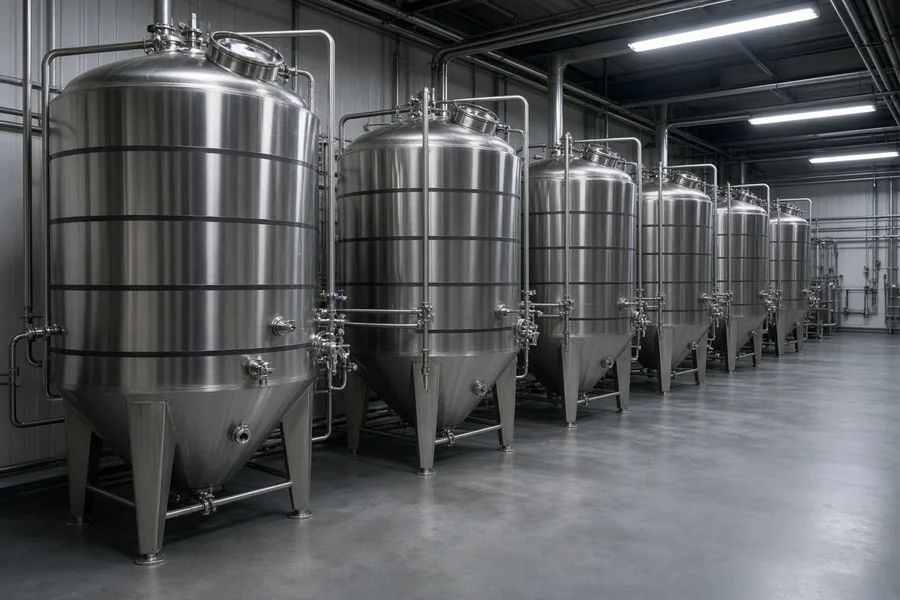
A glycol solution is standard here because most fermentation setpoints run below what a plain-water loop can reach reliably, and because the same loop often needs to hold a bright tank or serving line at an even colder temperature downstream. See Glycol Chillers for indoor and outdoor packages sized to fermentation-scale heat loads.
Request a QuoteSizing Fermentation Cooling
Fermentation heat is metabolic, not mechanical - it's generated by the culture itself, and it varies through the fermentation cycle rather than holding flat. Most fermentation cooling calls for jacket or coil cooling on the vessel, sized to the peak heat output near the middle of the cycle rather than the average across the whole run.
Where a plant runs multiple fermentation vessels on staggered schedules, the chiller sees a rolling load rather than one flat peak - worth flagging when you send us the vessel count and schedule, since it can change whether one central chiller or several smaller Advantage units makes more sense.
Send Us
- Vessel volume and jacket/coil area
- Required fermentation temperature and peak metabolic heat output
- Number of vessels and whether schedules overlap
- Indoor or outdoor installation
TYPICAL RANGES BY FERMENTATION TYPE
| Process Type | Leaving Fluid Temp | Load Profile | Notes |
|---|---|---|---|
| Warm/ambient fermentation | 50-70°F | Batch, moderate peak | Water or low-% glycol |
| Cold fermentation | 34-50°F | Batch, high mid-cycle peak | 20-30% glycol |
| Multi-vessel staggered schedule | Varies by vessel | Rolling, overlapping peaks | Central system common above 3-4 vessels |
Ranges are typical starting points - actual leaving fluid temperature depends on your specific culture, vessel size and target cycle time. Call and talk it through with an engineer: 1-805-484-2992.