
1-805-484-2992
Quotes - Engineering - SalesRAPID PRODUCT COOLDOWN
Out of the
Danger Zone, Fast
Pasteurization only accomplishes its job once the product is also cooled quickly afterward. Product held too long in the intermediate temperature range after heat treatment gives surviving organisms time to recover, so plate-and-frame or tubular heat exchangers on the cold side of a pasteurizer need a chilled fluid supply from an Advantage chiller, cold enough and steady enough to hit the required cooldown time every batch, every shift.
The Advantage chiller's job here is consistency under a swinging load: cooldown demand spikes when a batch comes off the pasteurizer and drops between runs, and a chiller sized only for average load will fall behind on the fluid temperature right when the product needs it most.
- Rapid cooldown after heat treatment limits time in the food-safety danger zone
- Chiller must hold fluid temperature through load spikes, not just average demand
- Plain chilled water or glycol depending on the target product temperature
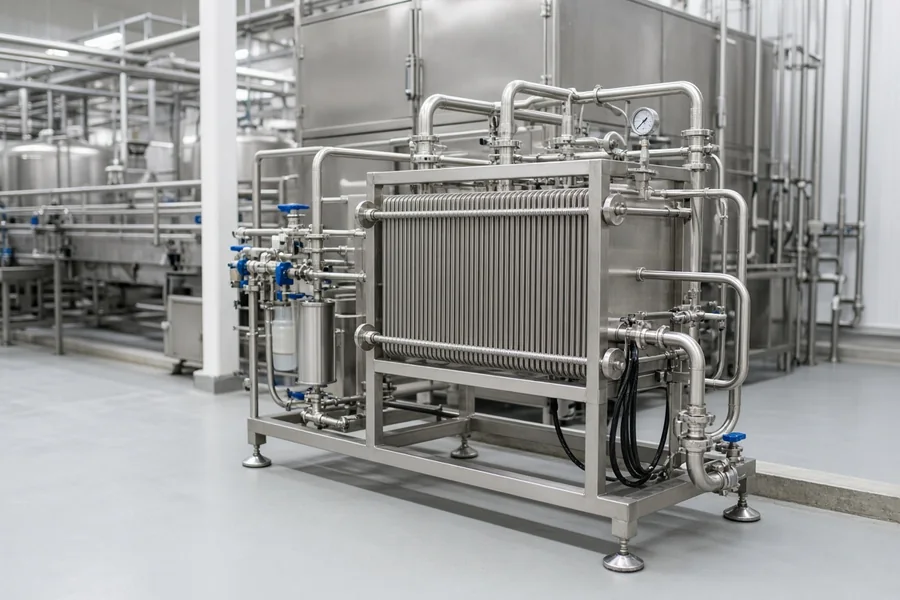
Depending on the target product temperature, this loop runs on plain chilled water or on a glycol solution - see Central Chillers for plant-wide chilled water or Glycol Chillers where the target temperature runs below what water alone can deliver.
Request a QuoteSizing Post-Pasteurization Cooldown
Pasteurization cooldown is a race against the food-safety clock: product has to drop through the danger zone within a defined time window, which makes this one of the highest-peak, shortest-duration loads on a food plant's cooling system. The Advantage chiller has to deliver cold fluid fast enough to hit that window on every batch, not just on average.
Because cooldown typically happens in a plate-and-frame or tubular heat exchanger right after the pasteurizer, the chiller's flow rate and approach temperature both matter as much as raw tonnage - undersizing either one stretches the cooldown time even if total capacity looks adequate on paper.
Send Us
- Product throughput and required cooldown time
- Target leaving fluid temperature at the heat exchanger
- Heat exchanger type (plate-and-frame or tubular)
- Whether cooldown overlaps with other process loads on the same loop
TYPICAL RANGES BY PRODUCT
| Product Type | Leaving Fluid Temp | Load Profile | Typical Fluid |
|---|---|---|---|
| Dairy / beverage pasteurization | 28-34°F | Batch, very high peak | 30-35% propylene glycol |
| Juice / liquid egg pasteurization | 30-36°F | Batch, high peak | 25-30% propylene glycol |
| Sauce / prepared-food pasteurization | 34-38°F | Batch, moderate peak | 20-25% propylene glycol |
Ranges are typical starting points - actual leaving fluid temperature depends on your specific product, throughput and required cooldown time. Call and talk it through with an engineer: 1-805-484-2992.