
1-805-484-2992
Quotes - Engineering - SalesIMAGING & MRI CHILLED WATER
Built to the
OEM Specification
CT scanners, X-ray systems and other diagnostic imaging equipment generate substantial heat in their power electronics and imaging components, and the manufacturer's installation specification typically calls out a required chilled water temperature, flow rate and, often, a maximum allowable interruption before the equipment shuts down to protect itself.
MRI systems raise the bar further: chilled water has to hold the magnet and gradient coil systems within a narrow, stable temperature band, because temperature swings at the magnet show up as image quality problems and, on some systems, affect magnet stability itself. That tolerance has to hold through the gradient coil's cyclical heat load during active scanning, not just at idle. MRI suites in colder climates or unconditioned mechanical spaces often run a glycol loop for freeze protection - see Advantage Glycol Chillers - while a controlled mechanical room may run plain chilled water if the manufacturer's specification allows it.
- Imaging and MRI equipment manufacturers specify required chilled water temperature and flow
- MRI magnet and gradient coil cooling requires a tighter, more stable temperature band
- Downtime cancels patient appointments, raising the reliability bar for the chiller
- Glycol loops common where freeze protection is needed for the chiller location
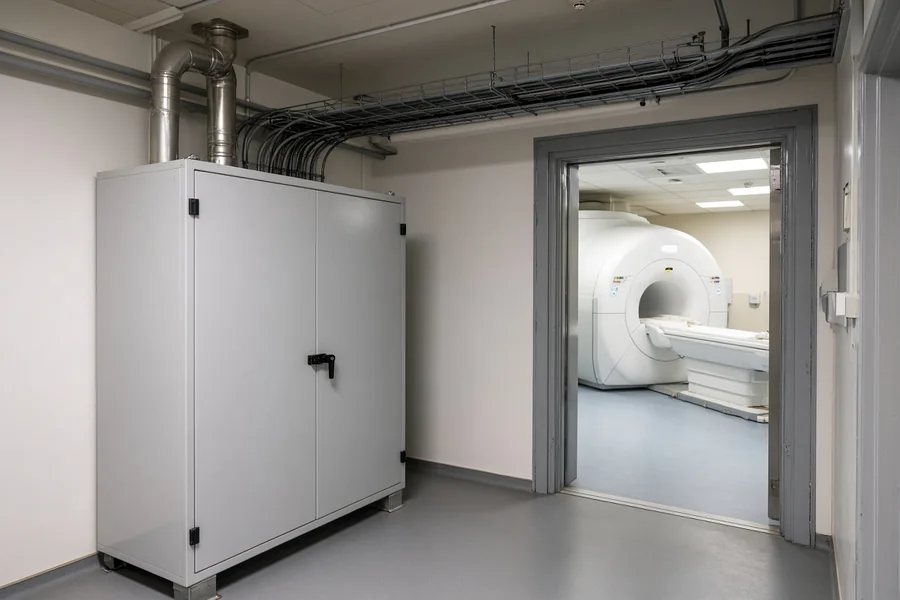
Because imaging and MRI downtime cancels patient appointments and backs up a schedule, these systems are often sized with more margin, and sometimes backup capacity, than an equivalent industrial load of the same tonnage would warrant. Send us the equipment manufacturer's cooling specification sheet directly - required fluid temperature, flow rate and any stated stability or reliability requirement - and we'll size and configure an Advantage chiller against that specification rather than a general estimate.
Request a QuoteSizing MRI Magnet Cooling
MRI superconducting magnet cooling runs to a tight tolerance set entirely by the scanner manufacturer's utility specification - there's no generic industry setpoint to fall back on. The Advantage chiller we select has to match the OEM's required supply temperature, flow rate and stability band precisely, since running outside spec risks both image quality and equipment warranty.
Because an MRI suite's imaging schedule is booked in advance and hard to reroute, uptime and backup planning matter as much as base sizing - many facilities either build in redundancy or keep a portable backup unit arrangement in place for exactly this reason.
Send Us
- MRI system manufacturer and model (for the exact utility spec)
- Required coolant supply temperature, flow rate and stability tolerance
- Fixed suite, mobile trailer, or rental installation
- Backup/redundancy requirement
TYPICAL RANGES BY INSTALLATION TYPE
| Installation Type | Coolant Supply Temp | Stability Tolerance | Notes |
|---|---|---|---|
| Fixed hospital/clinic suite | 50-68°F | ±1-2°F (OEM-set) | Confirm exact OEM spec before quoting |
| Mobile/rental imaging trailer | 50-68°F | ±1-2°F (OEM-set) | Compact, transportable unit required |
| Multi-suite imaging center | 50-68°F | ±1-2°F (OEM-set) | May justify a shared central system |
Ranges are typical starting points only - MRI magnet cooling must be sized to the exact manufacturer utility specification, not a general range. Call and talk it through with an engineer: 1-805-484-2992.