
1-805-484-2992
Quotes - Engineering - SalesOverview
Add capacity to a chilled-water loop you already have with Advantage chiller modules, in 5 to 180 ton steps, without starting over.
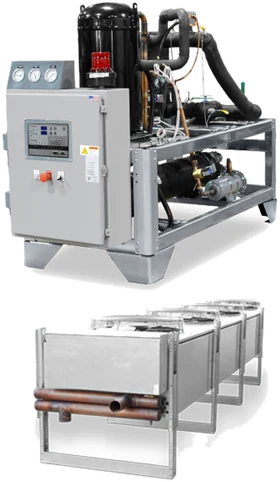
Advantage chiller modules are the refrigeration side only - compressor, condenser and evaporator - built to parallel onto a pump tank station rather than carry their own reservoir and pumps. That makes them the right tool for adding capacity to a plant that already has a chilled-water loop and a pump tank station in place, instead of replacing a working system to get more tons.
Each module is rated from 5 to 180 tons, and several of them share one pump tank station, so the plant-wide total climbs well past what any single packaged chiller can carry. A single factory-standard chiller package tops out around 180-210 tons; module-and-pump-tank combinations are how Advantage-equipped plants reach 300 tons and, in custom-engineered combinations, beyond that.
Because a module depends on an existing (or newly specified) pump tank station, sizing one correctly means looking at the whole loop - existing pump head and flow, reservoir volume, and how the new module's controls will stage against what's already running. Send us the current system's pump and reservoir specifications along with the additional load you need to add.
See the full part-number line-up for both module types: APT-RC (air-cooled, remote condenser) and WPT (water-cooled) chilling modules, 5 to 180 tons each.
- 5 to 180 tons per module - no reservoir or pumps on the module itself
- Pairs with a pump tank station (see Accessories & Options) to build or expand a loop
- Plant-wide totals to 300 tons are achieved by paralleling modules, not a single package
- Larger combined plants are custom-engineered - talk to us about the target total tonnage
Module Types
Two module families, one pump tank station - the difference is how the condenser is cooled.
| Module | Capacity Range | Leaving Fluid Temp | Condensing |
| APT-RC | 5 to 180 tons | 20 to 80°F | Air-cooled, remote condenser |
| WPT | 5 to 180 tons | 20 to 80°F | Water-cooled, tower-connected |
| Paralleled Modules | Combined to 300 tons+ | Per-module setpoint | Staged against one pump tank station |
Naming vs. Actual Tonnage
Module part numbers name a nominal capacity that doesn't always match the actual delivered tonnage at your leaving fluid temperature - the CC-100APT-RC is rated at 90 tons and the CCC-150APT-RC at 135 tons even at the standard 50°F rating point, and colder setpoints deliver less again. Compare modules by their capacity table at your specific setpoint, not by the number in the part name.
Advantage remote-condenser (APT-RC) modules add a refrigerant line-set run between the compressor/evaporator skid and the outdoor condenser coil - line length and vertical rise both factor into proper line sizing, so the approximate routing distance from mechanical room to condenser location should be part of the initial quote conversation.
Module Sizing
What We Need to Size an Add-On Module
A module has to fit the station it joins. These details let us match its tonnage, controls and condenser to the loop you already run:
- Tons to add, the GPM the new load brings, and the fluid temperature it needs
- Pump tank station data: reservoir gallons, pump flow and head
- Remote air-cooled condenser (APT-RC) or tower water (WPT)
- APT-RC only: line-set length and vertical rise to the condenser coil
- Spare valved tees on the headers, or the shutdown window you can give us
Call and talk it through with an engineer: 1-805-484-2992
Adding a module without upsetting the running loop
Call and talk it through with an engineer: 1-805-484-2992