
1-805-484-2992
Quotes - Engineering - SalesSPINDLE & COOLANT CONTROL
Holding Tolerance
Through the Shift
CNC spindles generate heat at speed, and as metal heats up it grows - enough thermal growth in a spindle or machine frame to push a precision part out of tolerance, particularly on longer runs or tighter-tolerance work. An Advantage chiller circulating coolant through the spindle jacket, and often through the cutting coolant as well, holds the machine at a stable thermal state instead of letting it drift warmer through the shift.
Coolant temperature control does double duty: it manages heat at the cutting edge for tool life and surface finish, and on machines with coolant-through-spindle tooling, it's also part of chip evacuation and workpiece cooling. A chiller sized to the machine's actual heat load, run at a stable setpoint, does both jobs better than plant water at an uncontrolled ambient temperature.
- Spindle jacket cooling limits thermal growth that erodes machining tolerance
- Coolant temperature control supports tool life, finish and chip evacuation
- Single-machine loads suit a portable chiller; multi-machine cells may suit a small central loop
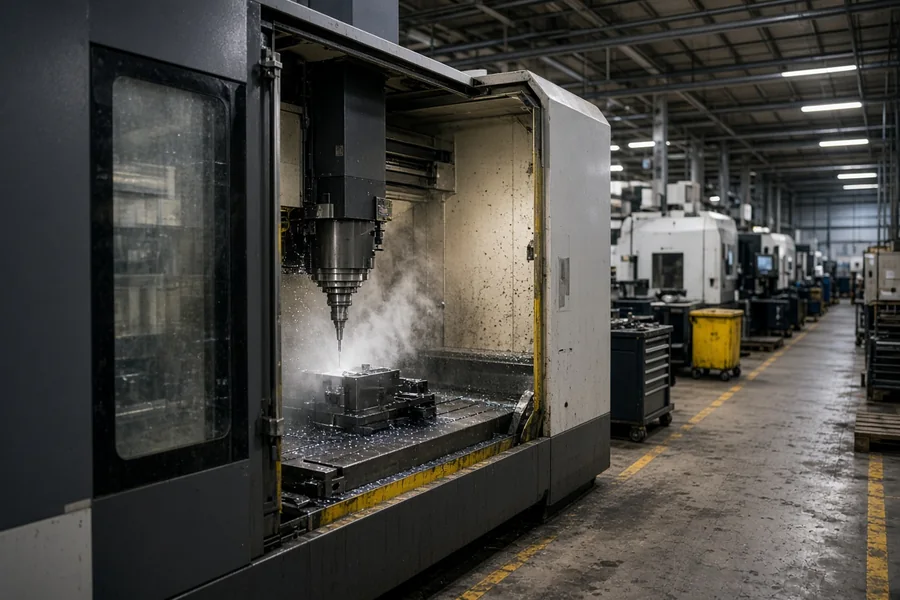
Single-machine loads in this category are a common fit for a dedicated Advantage portable chiller; multi-machine cells sharing a coolant supply may do better on a small central loop. Tell us the machine's spindle horsepower or published cooling requirement and we'll size accordingly.
Request a QuoteSizing Machine Tool Coolant & Spindle Cooling
Precision machining is sensitive to thermal growth - a spindle, coolant loop or machine structure that drifts even a few degrees can shift part dimensions outside tolerance, especially on tight-tolerance or high-precision work. Coolant temperature stability, not just raw cooling capacity, is what protects dimensional accuracy across a production run.
Coolant duty typically covers both spindle cooling and cutting-fluid temperature control, and each machine builder specifies its own tolerance for both. On a multi-machine cell, we size the Advantage chiller and loop for the tightest-tolerance machine on it, not the average across the group.
Send Us
- Number of machines and each one's coolant temperature/flow spec
- Required stability tolerance (tightest machine on the loop)
- Cutting fluid or coolant type in use
- Indoor installation, typical shop ambient range
TYPICAL RANGES BY PRECISION CLASS
| Machine Class | Leaving Fluid Temp | Stability Tolerance | Notes |
|---|---|---|---|
| Standard CNC machining | 68-75°F | ±2-3°F | General-purpose tolerance work |
| Precision / tight-tolerance machining | 65-70°F | ±1°F | Grinding, high-precision turning/milling |
| High-speed spindle cooling | 65-72°F | ±1-2°F | Confirm OEM spindle coolant spec |
The machine builder's coolant and spindle specification overrides any figure in this table - confirm it before a unit is chosen.
Call and talk it through with an engineer: 1-805-484-2992.
Thermal growth and the coolant loop that stops it
Call and talk it through with an engineer: 1-805-484-2992