
1-805-484-2992
Quotes - Engineering - Sales
OACS Series
| PRODUCT | TYPE | CAPACITY | COOLING |
|---|---|---|---|
| Central Chiller | Outdoor Package | 5 – 150 Tons | Air-Cooled |
Specifications
Configuration & Size
Capacity:
5 – 150 Tons
Zones:
Single or Dual
Standard Models:
22
Installation:
Outdoor, Self-Contained
Brand:
Advantage
Construction
- Compressors: Scroll, Tandem or Digital Scroll
- Evaporator: Brazed Plate
- Reservoir: Polyethylene
- Controls: MG or MZC Series
OACS Series Outdoor Central Chillers
Self-Contained, Single- or Dual-Zone
OACS is Advantage's outdoor central chiller platform — a weatherproof package that ships fully charged and tested, ready to set on a pad outside the building. There's no mechanical room to find space in, no cooling tower to maintain, and no plant-water budget to plan around: connect power and the process piping, fill the loop, and the unit runs. Twenty-two standard models cover roughly 5 to 150 tons across single-zone and dual-zone configurations.
Single-zone OACS units (OACS-5S through OACS-60S) deliver one chilled-fluid temperature to the whole connected loop, scaling from a compact 5-ton Scroll-compressor package up through tandem-Scroll units near 55 tons. Dual-zone OACS units (OACS-10D through OACS-150D) produce two independently controlled fluid temperatures from one chiller frame using an MZC multizone controller with independent zone boards and independent compressor staging per zone — the right answer when part of a plant needs a colder process fluid than the rest of it, without running two completely separate outdoor chiller packages.
The entire OACS line runs R-454B with one deliberate exception: OACS-150D-MZC-2P, the largest dual-zone frame, is built on R-513A with a rotary Screw compressor, a shell-and-tube evaporator and a stainless-steel reservoir — all different from the brazed-plate evaporator and polyethylene reservoir used across every smaller OACS model. That's a genuine construction break, not a naming quirk, and it means different service procedures and different spare parts than the rest of the line. If you're standardizing spare parts or service training across multiple OACS units on one site, plan for that unit separately.
A handful of the dual-zone models' published per-zone and total tonnage figures don't cleanly multiply out (a per-zone figure times two doesn't equal the published total on some models). We've published every number exactly as Advantage's own product pages state it, with an inline flag on each affected model rather than adjusting either figure to make them agree — if an exact per-zone number matters for your sizing, confirm it against the literature PDF or with us directly before finalizing a quote.
One more detail worth knowing before requesting a manual: OACS uses two different manual PDFs depending on configuration, not one manual for the whole series — single-zone (S-suffix) models ship with an OACS-MG manual, and dual-zone (D-suffix) models ship with a separate OACS dual-zone manual. Each PN page on this site links the correct one for that specific model.
Outdoor, self-contained central chillers with the reservoir and pump in the package, single- or dual-zone.
Request a QuoteOACS Series Applications

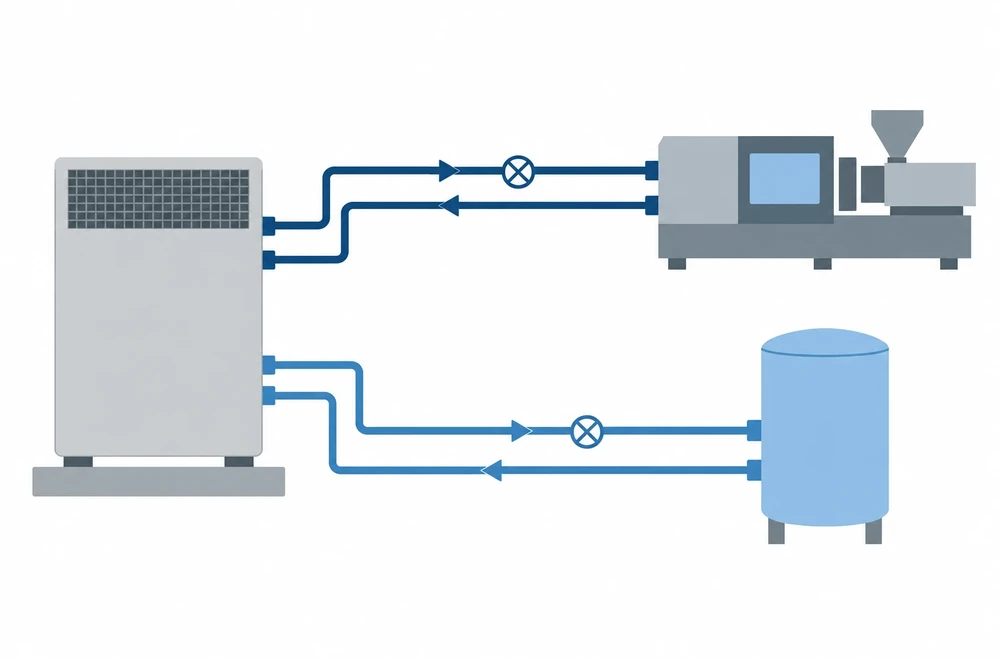
Single-Zone or Dual-Zone Is a Process Question, Not a Tonnage Question
The instinct is to pick a dual-zone OACS frame whenever a plant has two process loops, but that's not always the right call. A dual-zone unit is the right tool when both loops genuinely need independent temperature setpoints running at the same time — otherwise, two single-zone units (or one single-zone unit sized for the combined load) can be simpler to service, since a fault on one zone's compressor doesn't touch the other loop's controller or refrigerant circuit.
Where dual-zone wins outright is footprint and installed cost per ton when both loops really do run concurrently: one weatherproof cabinet, one pad, one set of power and water-makeup connections instead of two. Tell us both loops' actual temperatures, flows and duty cycles — not just the combined tonnage — and we'll confirm whether a dual-zone frame or two single-zone units is the better fit before you commit to either. Call and talk it through: 1-805-484-2992
Sizing an OACS model comes down to four numbers per zone: the actual heat load in tons, the required leaving fluid temperature, the site's ambient temperature range, and the process connection size for each loop. Send us those and we'll confirm the model number and configuration (single- or dual-zone) rather than having you back-calculate it from a spec table.
Comparing an outdoor OACS package against an indoor Titan unit or a chilling module paired with a pump tank station? See Portable vs Central Chillers, or go straight to Request a Quote with your numbers.
Common FAQs
Single-Zone
| Model | Tons | Type | Cooling |
|---|---|---|---|
| OACS-5S-MG-1P | 5.3 | Outdoor, Air-Cooled, Single-Zone | Air-Cooled |
| OACS-7.5S-MG-1P | 7.8 | Outdoor, Air-Cooled, Single-Zone | Air-Cooled |
| OACS-10S-MG-1P | 10.2 | Outdoor, Air-Cooled, Single-Zone | Air-Cooled |
| OACS-15S-MG-1P | 14.4 | Outdoor, Air-Cooled, Single-Zone | Air-Cooled |
| OACS-20S-MG-1P | 18.9 | Outdoor, Air-Cooled, Single-Zone | Air-Cooled |
| OACS-25S-MG-1P | 24.2 | Outdoor, Air-Cooled, Single-Zone | Air-Cooled |
| OACS-30S-MG-1P | 28.8 | Outdoor, Air-Cooled, Single-Zone | Air-Cooled |
| OACS-40S-MG-1P | 38.4 | Outdoor, Air-Cooled, Single-Zone | Air-Cooled |
| OACS-50S-MG-1P | 42.7 | Outdoor, Air-Cooled, Single-Zone | Air-Cooled |
| OACS-60S-MG-2P | 55.1 | Outdoor, Air-Cooled, Single-Zone | Air-Cooled |
Dual-Zone
| Model | Tons | Type | Cooling |
|---|---|---|---|
| OACS-10D-MZC-2P | Outdoor, Air-Cooled, Dual-Zone | Air-Cooled | |
| OACS-15D-MZC-2P | 15.5 | Outdoor, Air-Cooled, Dual-Zone | Air-Cooled |
| OACS-20D-MZC-2P | 20.2 | Outdoor, Air-Cooled, Dual-Zone | Air-Cooled |
| OACS-25D-MZC-2P | 25 | Outdoor, Air-Cooled, Dual-Zone | Air-Cooled |
| OACS-30D-MZC-2P | 30 | Outdoor, Air-Cooled, Dual-Zone | Air-Cooled |
| OACS-40D-MZC-2P | 37.2 | Outdoor, Air-Cooled, Dual-Zone | Air-Cooled |
| OACS-50D-MZC-2P | 48.4 | Outdoor, Air-Cooled, Dual-Zone | Air-Cooled |
| OACS-60D-MZC-2P | 57.4 | Outdoor, Air-Cooled, Dual-Zone | Air-Cooled |
| OACS-80D-MZC-2P | Outdoor, Air-Cooled, Dual-Zone | Air-Cooled | |
| OACS-100D-MZC-2P | 169.2 | Outdoor, Air-Cooled, Dual-Zone | Air-Cooled |
| OACS-120D-MZC-2P | 220.2 | Outdoor, Air-Cooled, Dual-Zone | Air-Cooled |
| OACS-150D-MZC-2P | 145.8 | Outdoor, Air-Cooled, Dual-Zone | Air-Cooled |