
1-805-484-2992
Quotes - Engineering - SalesDIE COOLING
Heat Out Before
the Next Shot
Every shot dumps a large amount of heat into the die, and the die has to give that heat back up before the next shot to hold dimensional accuracy and avoid soldering, porosity and surface defects. An Advantage chiller circulating cooling water through the die's internal cooling lines controls how quickly and how evenly that heat comes back out, which sets both achievable cycle time and casting quality shot after shot.
Because die casting heat loads are high and cyclical - a spike at each shot rather than a steady draw - the chiller and its pumping system need enough capacity and turndown to keep up with the actual shot rate, not just the averaged heat load across an hour.
- Die cooling controls dimensional accuracy and defect rates shot after shot
- Cyclical, spiking heat load requires chiller capacity matched to shot rate, not average load
- Single-machine dies often suit a portable chiller; multi-machine cells often move to central
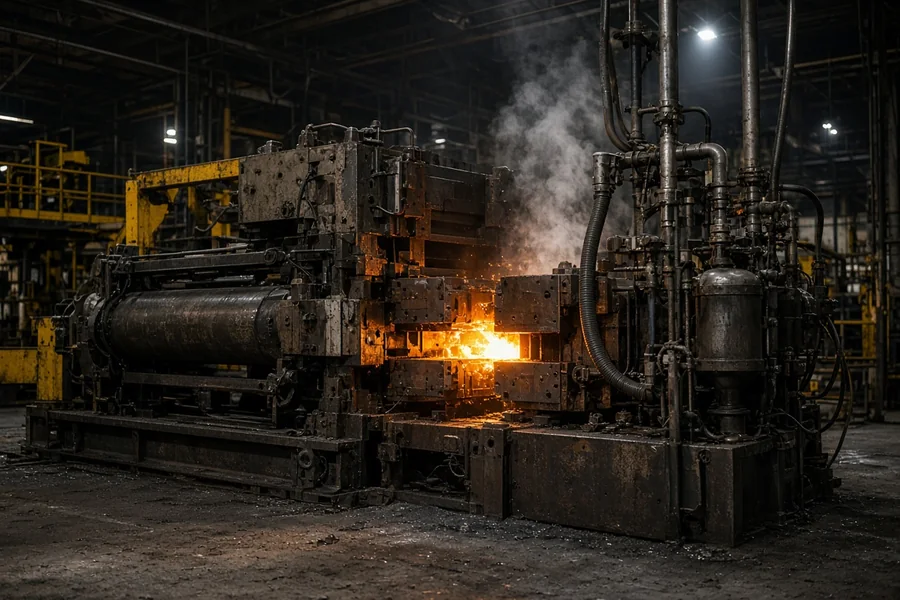
Die cooling loads at a single machine are often sized for a dedicated Advantage portable or small central chiller; multi-machine die casting cells frequently move to a shared central loop as the number of machines grows. Tell us the machine's shot rate, alloy, and part weight, and we'll help estimate the heat load.
Request a QuoteSizing Die Casting Cooling
Die cooling sets cycle time directly: the faster the die can shed the heat injected by each molten-metal shot, the sooner it can be opened, ejected and closed again for the next cycle. Undersized cooling doesn't just risk part defects like porosity or warping - it caps the line's maximum shots-per-hour, which is usually the more expensive problem.
Die temperature also needs to stay within a process window, not just below a maximum - too cold a die can cause its own defects (cold shuts, poor fill), while too warm slows the cycle. We size Advantage chillers to the die's actual heat rejection per shot and the target cycle time, not a generic coolant temperature.
Send Us
- Die heat rejection per shot, or shots/hour and alloy being cast
- Target die temperature range and cycle time
- Number of dies/machines on the loop
- Air-cooled or water-cooled chiller preference
TYPICAL RANGES BY ALLOY
| Alloy Type | Leaving Fluid Temp | Load Profile | Notes |
|---|---|---|---|
| Zinc die casting | 60-80°F | Batch, per-shot spike | Lower melt temp, milder cooling load |
| Aluminum die casting | 50-70°F | Batch, high per-shot spike | Most common industrial die casting duty |
| Magnesium die casting | 50-65°F | Batch, high per-shot spike | Confirm fluid compatibility with process |
Ranges are typical starting points - actual leaving fluid temperature and tonnage depend on your specific die design, alloy and target cycle time. Call and talk it through with an engineer: 1-805-484-2992.