
1-805-484-2992
Quotes - Engineering - SalesCONDENSER COOLING
Condenser Temperature
Sets Recovery
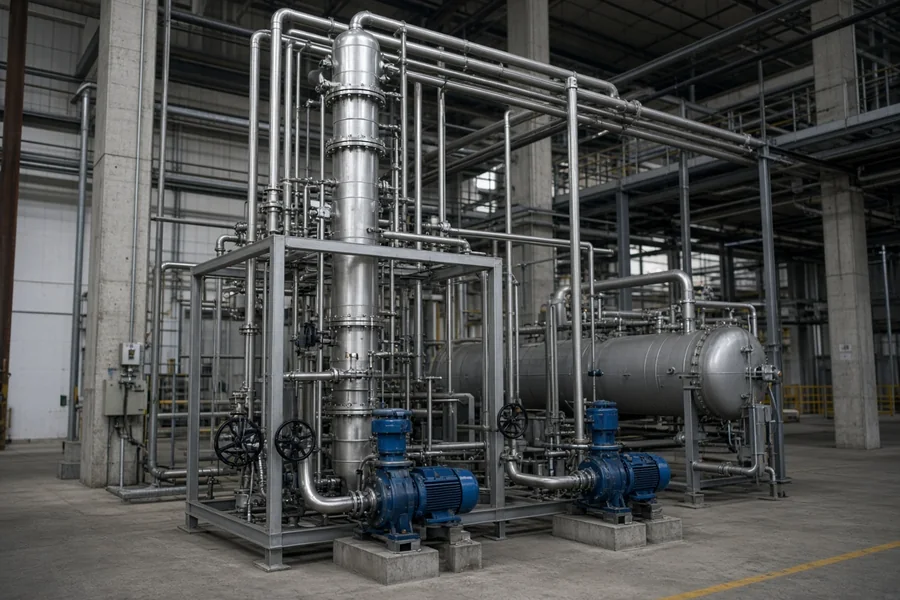
Solvent recovery and distillation systems condense vaporized solvent back to liquid for reuse, and how much solvent actually gets recovered - versus escaping as vapor - depends directly on how cold the condenser can run. A chiller feeding the condenser coil that can't hold its design temperature under load simply recovers less solvent per batch, which shows up as higher makeup-solvent cost and, often, as an emissions compliance issue.
Different solvents condense at different temperatures, and some recovery processes need well below 32°F to get acceptable recovery rates - which puts this squarely in glycol chiller territory rather than plain chilled water. See Glycol Chillers for the low-temperature range this typically requires.
- Condenser temperature directly sets solvent recovery efficiency
- Many recovery targets run below 32°F, requiring a glycol loop
- Sizing depends on solvent, target condensing temperature, and vapor load
Send us the solvent being recovered, the required condensing temperature, and the vapor load (or the heat duty if you already have it calculated), and we'll size an Advantage chiller to the actual recovery target rather than a round-number guess.
Request a QuoteSizing Solvent Recovery Condenser Cooling
A solvent recovery or distillation condenser's job is to hold vapor below its condensing temperature long enough to recover it as liquid rather than losing it overhead. The colder and more stable the condenser fluid temperature, the higher the recovery rate - a condenser running a few degrees too warm on a low-boiling solvent can measurably cut yield.
Recovery columns often run continuously rather than in the batch spikes typical of reactor jacket cooling, so the Advantage chiller sees a steadier load - but that load still has to be sized for the column's actual boil-up rate and the solvent's condensing temperature, not a generic chilled-water supply.
Send Us
- Solvent(s) being recovered and their condensing temperature
- Column boil-up rate or condenser duty in tons
- Continuous or batch column operation
- Whether solvent vapor could contact the chiller loop on a seal failure
TYPICAL RANGES BY SOLVENT CLASS
| Solvent Class | Leaving Fluid Temp | Load Profile | Typical Fluid |
|---|---|---|---|
| Higher-boiling solvents | 35-50°F | Continuous, steady | Water or low-% glycol |
| Mid-range solvents | 10-35°F | Continuous, steady | 30-40% glycol |
| Low-boiling / cryogenic-adjacent solvents | -10 to 10°F | Continuous, steady | 45-55% glycol |
Ranges are typical starting points - actual leaving fluid temperature depends on the specific solvent's condensing curve at your column's operating pressure. Call and talk it through with an engineer: 1-805-484-2992.