
1-805-484-2992
Quotes - Engineering - Sales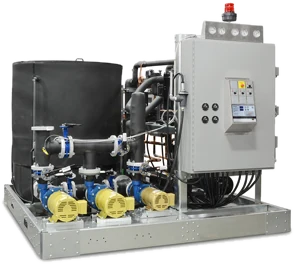
Titan Series
| PRODUCT | TYPE | CAPACITY | COOLING |
|---|---|---|---|
| Central Chiller | Indoor Package | 20 – 180 Tons | Air or Water |
Specifications
Configuration & Size
Capacity:
20 – 180 Tons
Cooling:
Air-Cooled or Water-Cooled
Standard Models:
26
Refrigeration Zones:
2 or 3
Brand:
Advantage
Construction
- Compressors: Scroll (Screw on 150 / 180-ton models)
- Installation: Indoor, Self-Contained
- Evaporator and Process Pumps Included
Titan Series Indoor Central Chillers
Refrigeration, Pumps and Reservoir in One Package
Twenty-six standard indoor packages with the compressor, evaporator, reservoir and pump on one frame.
Titan is Advantage's indoor central chiller platform — twenty-six standard packages from a 20-ton single-frame unit up to a 180-ton dual-zone split system, all built to sit inside a mechanical room with the compressor(s), evaporator, reservoir and process pump sharing one frame. Nothing about a Titan package is field-assembled from separate skids; it ships as one unit, gets set in place, plumbed and wired, and starts running the same week.
The line splits into two heat-rejection paths, and the choice between them is almost always a plant-water question rather than a tonnage question. Air-cooled Titan units reject heat through a remote condensing section — fans and coil on their own refrigerant line set, mounted outdoors or on a roof — so the mechanical room needs no tower connection, no plant water budget and no water treatment program. Water-cooled Titan units use city or tower condenser water instead, at the cost of a running water budget, but win on a smaller footprint per ton and a capacity that doesn't track outdoor ambient the way an air-cooled remote condenser does. If tower water is already piped to the mechanical room and isn't metered against the plant's utility bill, water-cooled is usually the better economic call at these tonnages; if it isn't, the air-cooled remote-condenser path avoids adding a water-treatment obligation to the plant's maintenance list.
Every Titan model below 150 tons runs fixed-speed or tandem Scroll compressors on R-454B, the same refrigerant used on MG portables of 3 tons and up. At 150 tons and up, the dual-zone WD-suffix models (TI-150WD, TI-180WD) switch construction entirely — two large rotary Screw compressors per unit, charged with R-513A instead of R-454B. That's not a paperwork difference: Screw compressors have different oil-return requirements, a different service interval, and different spare-parts stocking than a Scroll compressor, so treat those two models as their own product line when sourcing parts or planning maintenance rather than assuming Titan-wide interchangeability. One further note: TI-180W is listed with R-410A rather than the R-454B used across the rest of the single-zone Titan line, so confirm the refrigerant with us before ordering refrigerant-specific service parts for that unit.
Dual-zone Titan models (TI-120AD, TI-120WD, TI-150WD, TI-180WD) produce two independently controlled fluid temperatures from one chiller frame, with microprocessor-based zone boards handling individual compressor staging and (on most models) 50% hot-gas-bypass capacity control per zone. That's the answer when part of a plant needs a colder process fluid than the rest of it — injection molding tooling at one temperature and a hydraulic oil cooler at another, for example — without running two completely separate chiller packages and two separate mechanical-room footprints.
Capacity numbers on a handful of these models don't move in a straight line with the model number, and we've flagged every one on its own PN page rather than smoothing them into a tidy progression: the 100-ton-labeled TI-100A publishes 90 tons of actual capacity (TI-100W rates 100) (four 25-HP compressors — the model number tracks total compressor horsepower, not tonnage, on this frame), and TI-120W's water-cooled capacity (127.8 tons) runs meaningfully above its air-cooled TI-120A sibling (120 tons) for the same nominal frame. None of that is a typo we're aware of; it's how Advantage's own pages publish these units, and we'd rather hand you the real number than round it to match the label.
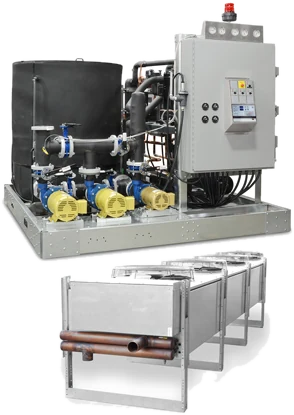
Titan air-cooled model shown; water-cooled models share the frame and add condenser water connections.
Request a QuoteTitan Series Applications




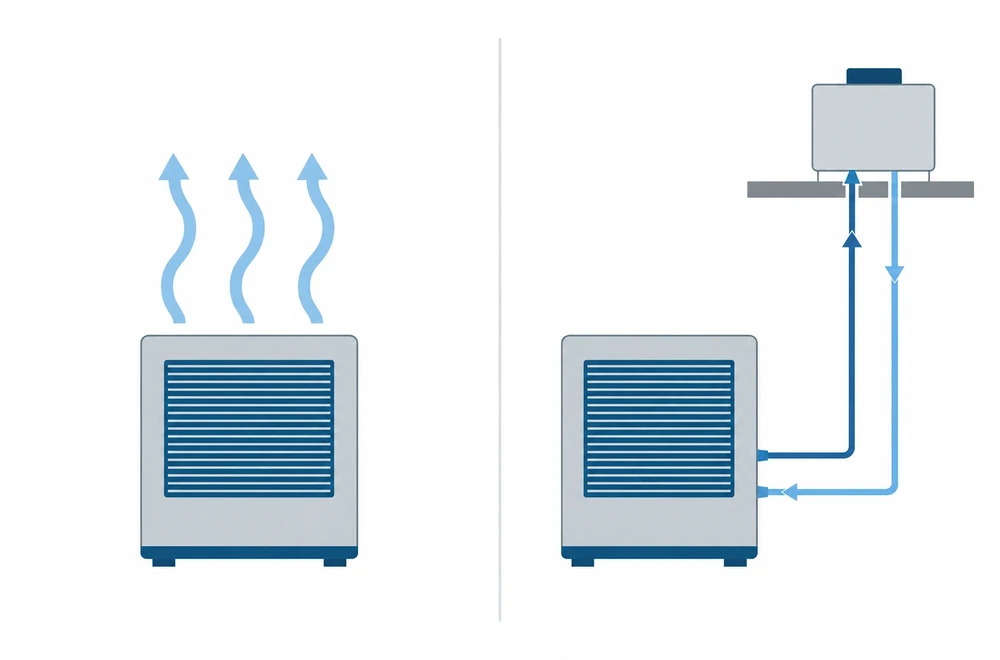
Air-Cooled vs. Water-Cooled Isn't Just a Footprint Decision
Nearly every Titan tonnage is available in both configurations, and it's tempting to pick whichever one fits the available floor space. That's the wrong first question. Air-cooled Titan units need a clear path for a refrigerant line set to an outdoor or rooftop condensing section — vertical lift, total equivalent length and elbow count all have to be checked against the compressor's charge and oil-return limits before the run is finalized. Water-cooled units need a tower or city water supply sized to the unit's actual condenser flow requirement, plus a drain, and (on a cooling tower loop) an ongoing water treatment program to keep the condenser tubes from scaling.
Get the wrong one specified and the fix is expensive: a water-cooled unit in
a building with no tower means adding one, and an air-cooled unit with no
viable line-set run to outdoor air means a mechanical-room redesign. Give us
the mechanical room's actual constraints — is there tower water, is there a
path to outdoor air, what's the realistic line-set run — before locking in a
configuration.
Call and talk it through with an engineer: 1-805-484-2992
Five answers pin down a Titan model: heat load in tons; leaving fluid temperature; whether the site has usable tower/city water or needs the air-cooled remote-condenser path; how many independent zones the process actually needs; and the process connection size you're plumbing into. With those in hand we name the exact model, so nobody has to work backward from a spec table.
Still deciding between a Titan indoor package and an outdoor OACS unit, or whether a chilling module against an existing pump tank station makes more sense than a self-contained frame? See Portable vs Central Chillers, or go straight to Request a Quote with your numbers.
Common FAQs
Air-Cooled
| Model | Tons | Type | Cooling |
|---|---|---|---|
| TI-20A | 20.5 | Indoor, Air-Cooled | Air-Cooled |
| TI-30A | 28.5 | Indoor, Air-Cooled | Air-Cooled |
| TI-40A | 40 | Indoor, Air-Cooled | Air-Cooled |
| TI-50A | 50 | Indoor, Air-Cooled | Air-Cooled |
| TI-60A | 57 | Indoor, Air-Cooled | Air-Cooled |
| TI-80A | 80 | Indoor, Air-Cooled | Air-Cooled |
| TI-90A | 85.5 | Indoor, Air-Cooled | Air-Cooled |
| TI-100A | 90 | Indoor, Air-Cooled | Air-Cooled |
| TI-120A | 120 | Indoor, Air-Cooled | Air-Cooled |
| TI-120AD | 120 | Indoor, Air-Cooled | Air-Cooled |
| TI-150A | 135 | Indoor, Air-Cooled | Air-Cooled |
| TI-180A | 180 | Indoor, Air-Cooled | Air-Cooled |
Water-Cooled
| Model | Tons | Type | Cooling |
|---|---|---|---|
| TI-20W | 20.5 | Indoor, Water-Cooled | Water-Cooled |
| TI-30W | 30 | Indoor, Water-Cooled | Water-Cooled |
| TI-40W | 40 | Indoor, Water-Cooled | Water-Cooled |
| TI-50W | 50 | Indoor, Water-Cooled | Water-Cooled |
| TI-60W | 60 | Indoor, Water-Cooled | Water-Cooled |
| TI-80W | 85.2 | Indoor, Water-Cooled | Water-Cooled |
| TI-90W | 90 | Indoor, Water-Cooled | Water-Cooled |
| TI-100W | 100 | Indoor, Water-Cooled | Water-Cooled |
| TI-120W | 127.8 | Indoor, Water-Cooled | Water-Cooled |
| TI-120WD | 120 | Indoor, Water-Cooled | Water-Cooled |
| TI-150W | 150 | Indoor, Water-Cooled | Water-Cooled |
| TI-150WD | 147 | Indoor, Water-Cooled | Water-Cooled |
| TI-180W | 180 | Indoor, Water-Cooled | Water-Cooled |
| TI-180WD | 178 | Indoor, Water-Cooled | Water-Cooled |