
1-805-484-2992
Quotes - Engineering - SalesIMMERSION CHILL TANKS
Chill Water That
Holds Under Load
Immersion chill tanks bring poultry product down to holding temperature immediately after processing, and USDA regulations set specific time-and-temperature targets for that cooldown. Holding chill tank water at the required temperature under a continuous product load - not just at startup, before the tank has absorbed any heat - is what keeps a line in compliance.
Chill tank heat load is continuous and predictable in a running plant, which makes it a good fit for an Advantage central chilled-water loop sized to the plant's full processing rate rather than a chiller per tank. Where product temperature needs to run colder than plain water allows, an Advantage glycol chiller extends the achievable range.
- Immersion chill tank water temperature drives USDA cold-chain compliance
- Continuous plant-wide load - a strong fit for a central chilled-water loop
- Glycol extends the range where colder-than-water temperatures are required
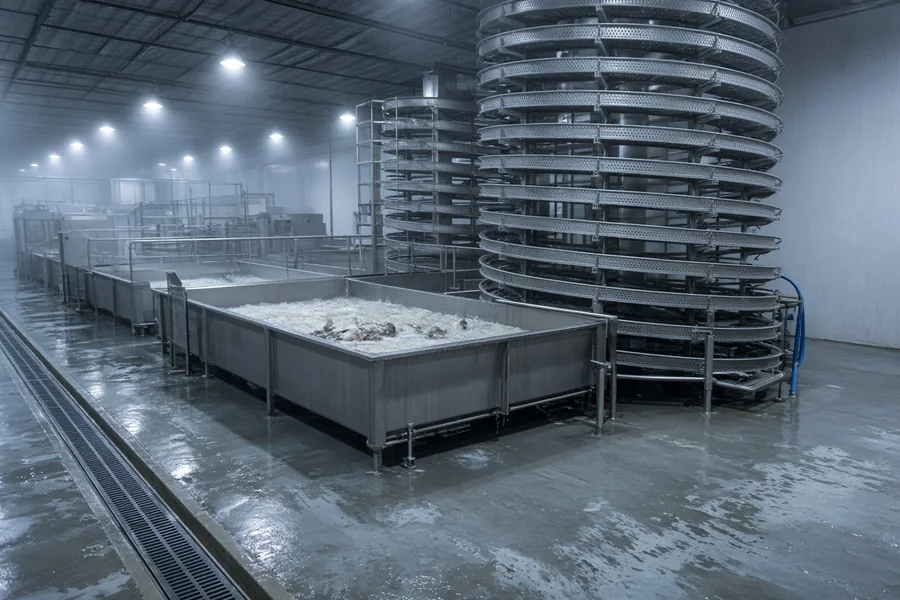
Because a chill tank interruption stops the line, redundancy and turndown matter as much as raw tonnage here - talk to us about your processing rate and required chill tank temperature and we'll help size the loop with the plant's actual duty cycle in mind.
Request a QuoteSizing Poultry Chill Tank Cooling
Poultry chilling is a cold-chain-compliance load first: immersion chill tank water has to hold a target temperature that pulls carcass temperature down within a regulated time window, on a continuous basis through a full processing shift. The tank's water volume, product throughput and target temperature together set the required tonnage.
Because chill tank water is displaced and refreshed continuously as product moves through, the load behaves more like a steady industrial process duty than a batch spike - but the Advantage chiller still has to be sized for peak throughput, including any startup period where tank water is being pulled down from ambient.
Send Us
- Chill tank volume and water turnover rate
- Target chill tank water temperature
- Product throughput (birds/hour or lb/hour)
- Startup pulldown time requirement
TYPICAL RANGES BY CHILL STAGE
| Chill Stage | Leaving Fluid Temp | Load Profile | Notes |
|---|---|---|---|
| Pre-chill / initial immersion | 36-40°F | Continuous, high volume | Bulk carcass temperature reduction |
| Final chill tank | 32-36°F | Continuous, steady | Holds cold-chain compliance target |
| Tank pulldown at shift startup | 32-40°F | High peak, short duration | Sized separately from steady-state load |
Ranges are typical starting points - actual leaving fluid temperature and tonnage depend on your specific throughput, tank volume and regulatory chill-time target. Call and talk it through with an engineer: 1-805-484-2992.